




Eighty And Out (Slight Return)
Dave Wilson |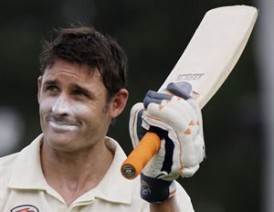
When Michael Hussey shot out of the blocks to register the astounding average of 84.80 in his first 33 innings, this feat was described as “Bradmanesque”, yet another word to add to our ever-expanding sporting lexicon. This was admittedly based mainly on comparison of Hussey’s average to the famous 99.94 compiled by Bradman over his Test career, but Bradman’s test career covered 21 years, whereas Hussey had been playing for only two and a half years at that point. It’s much more impressive to maintain such a high average over such a lengthy Test career than for a relatively short period, however I did wonder just how comparable Hussey’s performances were to those of the great man, and I decided the only way to compare them was as directly as is possible, that is over the first 33 innings of Bradman’s career.
Here are the main figures compiled by both batsmen:-
| Bradman | Hussey | |
| Runs | 3020 | 2120 |
| Innings | 33 | 33 |
| Not Out | 3 | 8 |
| Average | 100.67 | 84.80 |
| 50s | 17 | 14 |
Bradman scored almost half as many runs again as did Hussey, but it’s when we look at the big scores each man compiled that the gap between them is most apparent – of the 17 scores over fifty made by Bradman, he converted an amazing 76% of them into centuries, and, even more amazing, six of his thirteen hundreds were doubles or better. Hussey, on the other hand, had almost as many scores over fifty, however only four were centuries (28% conversion rate) and none were doubles. It would appear that Hussey, with his higher number of incomplete innings, was more the beneficiary of the method by which averages are calculated – looking solely at per-innings averages, Bradman comes out at 91.51 to Hussey’s 64.24. So the only thing “Bradmanesque” about Hussey’s performance was his high average.
However, I’m not here to pick on Michael Hussey, but I did wonder if anyone else, in their early days, has approached the Don’s level of greatness. I decided to look at all batsmen through the years to see who has scored the most runs over their first 80 innings (limited to 80 as Bradman played 80 innings over his test career) – here are the top twenty:
| Player | Runs | Average |
| Bradman (Aus) | 6996 | 99.94 |
| Weekes (WI) | 4446 | 59.28 |
| Sutcliffe (Eng) | 4425 | 61.46 |
| Richards (WI) | 4411 | 58.04 |
| Hobbs (Eng) | 4384 | 60.05 |
| Hutton (Eng) | 4191 | 58.21 |
| Hayden (Aus) | 4185 | 57.33 |
| Sobers (WI) | 4178 | 58.85 |
| Hammond (Eng) | 4096 | 57.69 |
| Sehwag (Ind) | 4062 | 52.75 |
| Lara (WI) | 4060 | 52.05 |
| Harvey (Aus) | 4006 | 54.14 |
| Gavaskar (Ind) | 3951 | 53.39 |
| Pietersen (Eng) | 3890 | 50.52 |
| Dravid (Ind) | 3871 | 54.52 |
| Worrell (WI) | 3792 | 53.41 |
| Smith GC (SA) | 3728 | 49.71 |
| Chappell GS (Aus) | 3724 | 55.58 |
| Barrington (Eng) | 3708 | 51.50 |
| Kanhai (WI) | 3696 | 47.38 |
Everton Weekes came closest, however even he was more than 2,500 runs off the Don’s pace. Given the amount of cricket played nowadays, batsmen today reach 80 innings in a much shorter time period than players of the 1930s and 1940s, and are therefore much younger and possibly not at their peak, so let’s expand the search a little bit by taking the best consecutive 80 innings for each batsman:
| Player | Runs | Average |
| Bradman (Aus) | 6996 | 99.94 |
| Ponting (Aus) | 5052 | 74.29 |
| Lara (WI) | 4972 | 63.74 |
| Sobers (WI) | 4969 | 73.07 |
| Mohammad Yousuf (Pak) | 4884 | 66.90 |
| Tendulkar (Ind) | 4767 | 66.21 |
| Hobbs (Eng) | 4753 | 63.37 |
| Hayden (Aus) | 4743 | 65.88 |
| Richards (WI) | 4741 | 60.78 |
| Kallis (SA) | 4711 | 71.38 |
| Dravid (Ind) | 4652 | 68.41 |
| Hutton (Eng) | 4635 | 67.17 |
| Javed Miandad (Pak) | 4578 | 61.04 |
| Barrington (Eng) | 4547 | 64.04 |
| Gavaskar (Ind) | 4528 | 59.58 |
| Sangakkara (SL) | 4509 | 60.12 |
| Inzamam-ul-Haq (Pak) | 4487 | 61.47 |
| Jayawardene (SL) | 4456 | 59.41 |
| Weekes (WI) | 4446 | 59.41 |
| Hammond (Eng) | 4439 | 63.41 |
The cream really is rising to the top now, with Ponting, Lara and Sobers in the top four – Ricky Ponting turns out to be the nearest to his countryman and with the next best average too. Still, there’s the issue of era-specifics – batsmen are scoring at a higher rate then ever these days, so the next section takes into account the average number of runs a top order batsman would have scored in each decade, and shows each player’s aggregate runs above that. For example, in the period during which Bradman played, an average top-order batsman would have scored 2712 runs in 80 innings, so Bradman was 4284 runs above era. Here is the list of the highest above-era scores:
| Player | Runs Above Avg |
| Bradman (Aus) | 4284 |
| Sobers (WI) | 2328 |
| Ponting (Aus) | 2231 |
| Lara (WI) | 2151 |
| Hobbs (Eng) | 2111 |
| Tendulkar (Ind) | 2078 |
| Richards (WI) | 2070 |
| Mohammad Yousuf (Pak) | 2063 |
| Hutton (Eng) | 2030 |
| Weekes (WI) | 1939 |
| Hayden (Aus) | 1922 |
| Kallis (SA) | 1890 |
| Javed Miandad (Pak) | 1863 |
| Barrington (Eng) | 1856 |
| Dravid (Ind) | 1831 |
| Gavaskar (Ind) | 1813 |
| Hammond (Eng) | 1782 |
| Sutcliffe (Eng) | 1708 |
| Sangakkara (SL) | 1688 |
| Inzamam-ul-Haq (Pak) | 1666 |
So Garry Sobers now shows as the next best, moving ahead of Ponting and Lara. Still, Bradman is a mile ahead of everyone else. But there’s still one thing we’re not taking into account, which is those batsmen who, for various reasons, didn’t have the opportunity to amass 80 innings. Players such as Graeme Pollock, prevented by politics, George Headley, prevented by lack of tours and wartime, and the great players of the Golden Era, when much less Test cricket was played. To do that, we need to calculate the runs above average as a percentage; as an example, Bradman’s 4284 runs equates to 159.7% above era-average. This percentage is based only on the games in which Bradman played, with Bradman’s own performances excluded – in this way, each player is compared with his peers on an almost equal footing.
So here is our final top 25, showing the best batsmen’s percentage runs above the era average:-
| Player | % Above Avg |
| Bradman (Aus) | 159.7 |
| Abel (Eng) | 99.7 |
| Richards (WI) | 89.0 |
| Hobbs (Eng) | 88.5 |
| Headley (WI) | 85.4 |
| Sobers (WI) | 83.8 |
| May (Eng) | 82.6 |
| Hutton (Eng) | 82.6 |
| Lara (WI) | 76.3 |
| Ponting (Aus) | 75.9 |
| Harvey (Aus) | 75.5 |
| Steel (Eng) | 75.1 |
| Javed Miandad (Pak) | 74.4 |
| Gavaskar (Ind) | 73.8 |
| Tendulkar (Ind) | 73.7 |
| Sangakkara (SL) | 68.2 |
| Barrington (Eng) | 66.4 |
| Jayawardene (SL) | 66.3 |
| Hammond (Eng) | 66.0 |
| Mohammad Yousuf (Pak) | 65.9 |
| Jackson, FS (Eng) | 65.2 |
| Hayden (Aus) | 63.7 |
| Tyldesley, GE (Eng) | 63.3 |
| Sutcliffe (Eng) | 62.2 |
| Gooch (Eng) | 62.2 |
Once again, Bradman is head and shoulders above the rest. Bobby Abel’s inclusion at number two is very interesting – in the games in which Abel played, he scored twice as many runs as anyone else, although it should be noted he only played 22 innings in total. Viv Richards is the king of the modern era, followed by Jack Hobbs, George Headley, Sobers and Peter May. As with Abel, Allan Steel’s number 13 showing is a surprise, though again this was achieved with only 18 total innings. As for other notables who didn’t make the top 25, Geoff Boycott was ranked 29th, Everton Weekes is at 32, Graeme Pollock at 36, Border at 38, Compton at 40, Dexter at 44, Clem Hill at 46, with Gordon Greenidge rounding out the top 50.
Whichever way you slice it, Bradman was significantly ahead of all-comers in terms of run-production. He is both the source of the term and, surely the only batsman who can lay claim to the adjective “Bradmanesque”.

Interesting analysis.
Comment by andyc | 12:00am BST 3 September 2009
pretty cool, it just goes to show how far Bradman is ahead. also pity that not one NZ batsmen featured anywhere on those list, we really do have I work cut out for us all the best Jesse Ryder.
Comment by slugger | 12:00am BST 3 September 2009
wow… very interesting… can you give links to these tables you have created? will be interesting to study them.
Comment by Bagapath | 12:00am BST 4 September 2009
Thanks guys for the positive feedback..
Slugger, Crowe was the top New Zealander, at number 43, then a couple of guys who didn\’t play much, Dempster at 53 and Donnelly at 86.
Bagapath, let me see what I can do.
Comment by Dave Wilson | 12:00am BST 4 September 2009
Great analysis there mate, was an interesting read.
Comment by Amitpal_00 | 12:00am BST 4 September 2009
>> Still, there’s the issue of era-specifics – batsmen are scoring at a higher rate then ever these days, so the next section takes into account the average number of runs a top order batsman would have scored in each decade, and shows each player\’s aggregate runs above that.
Can you expand on this ? Why decade, and how do you handle it when players’ career span two decades ?
Wouldn’t it have been more accurate to take the average of top order players over all the matches played during their time ? For eg, if Bradman’s debut was in the Test match no.181 and his last match was no.320, take the averages of all top-6 (or is it top-7 ?) batsmen from all teams in those 140 matches. (I assume that you have access to some kind of a database. Even otherwise, it is doable using statsguru in a couple of hours.)
Comment by Tapioca | 12:00am BST 4 September 2009
Terrific piece. Nice work.
Comment by zaremba | 12:00am BST 4 September 2009
Top class, mate! Thanks for the great analysis!
Comment by Cricket Tragic | 12:00am BST 4 September 2009
very good work… and very insightful.. its amazing how statistical analysis can reveal so much…
Comment by cricfan | 12:00am BST 4 September 2009
Thanks for the comments guys.
Tapioca, I realised after your comment that I could improve on this – each player’s analysis in the era-specific section at the end now only takes into account those games in which he actually appeared, with his own performances excluded. In this way, we can compare hin to his peers on an almost equal footing. There are some surprises – would be interested in your opinions.
Comment by Dave Wilson | 12:00am BST 5 September 2009
Would like to see what happens to the last table if you set a min criteria of 40 completed innings. Must be the only way to remove those in the list who had very short careers.
Comment by Bagapath | 12:00am BST 5 September 2009
Hi bagapath – we’d lose Abel, Steel, Jackson and Tyldesley from the list, and Greg Chappell, Boycott, Kanhai and Inzamam would come in at the bottom of the 25. I don’t think a minimum number of innings is fair though – 40 innings covers about two or three years these days, whereas during the fifteen years covering Abel’s Test career only six players even reached 40 innings (Syd Gregory, Joe Darling, Hugh Trumble, Archie Mac, Clem Hill and Harry Trott).
Comment by Dave Wilson | 12:00am BST 5 September 2009
Great work Dave. I too am very interested in getting the link to the tables you’ve worked out!
Comment by KingKallis | 12:00am BST 5 September 2009
Fine work. Forgot to put that comment in the original post.
Comment by Tapioca | 12:00am BST 8 September 2009
Can i please have the info you used for this.
I am doing a high school project on bradman
Comment by Clarke | 12:00am BST 22 September 2009