




Sylvers
Martin Chandler |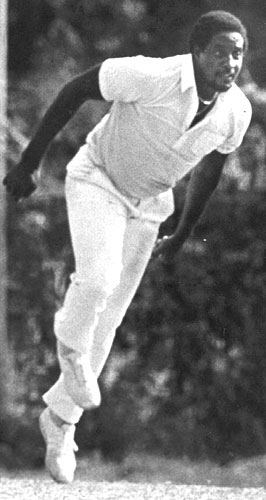
When I was growing up I lived in the wrong location for watching very much live cricket, and largely had to content myself with television coverage which, at that time, consisted of England’s home Test matches and ODIs, and a steady flow of domestic limited over games. An annual day out to one of the rare Lancashire matches at Blackpool, and some generally shambolic attempts by commercial television to cover the occasional “Roses” match, was the sum total of the County Championship cricket I saw.
In the early 1980s I spent three years at University, around twenty miles from London, and then a year in the capital itself, so not very far from the Oval or Lord’s. It was, to date, the only time in my life that I have had the opportunity to watch a reasonable amount of Championship cricket. The lure of Lord’s notwithstanding, and despite the somewhat shabby Oval of the time being rather more more distant from where I lived, after one trip to each it was the Oval I went back to, even though I had no affinity to the Surrey club. My semi-regular trips to Kennington were all down to one man, Sylvester Theophilus Clarke, who will always open the bowling for my All-time World XI.
In those days the Oval pitches were strange strips of turf. Generally they were pretty quick, but at the same time mild-mannered and the ball sped over a lightning fast outfield to provide a wicket that the Surrey batsmen seemed to enjoy batting on. But then some of the time they were very different, showing variable bounce and quickening up considerably. What was really remarkable was that they changed from over to over. A batsman’s playground when the likes of David Thomas, Graham Monkhouse and Robin Jackman were bowling, that turned into his worst nightmare when Sylvers was operating.
I had seen Sylvers on the television of course, and he looked quick then, and I knew he had a reputation for having a mean streak. But sitting in your armchair you don’t feel the batsman’s fear with him in the way I found I did at the ground. I also realised just how different fast bowlers look when operating to attacking fields, rather than the very standardised defensive formations that were invariably adopted in limited overs matches in England in those days.
So what was Sylvers like? Bill Frindall, who saw him so often from commentary positions, summed him up rather well, Lethally quick on his day, few fast bowlers have exuded such blatant and raw menace. The final throes of his action evoke visions of striking panthers and uncoiling snakes. The sight is vicious and awe-inspiring.
In his autobiography David Gower pondered the question as to who was the fastest bowler he had faced.I think Sylvester Clarke might receive my vote on the strength of several deliveries at the Oval one day. He ripped the top of my glove off, and he would also bowl you the occasional delivery you simply never saw. He also had a genuine streak of meanness that made it additionally unpleasant to face him.
Former Australia captain Steve Waugh, in his autobiography, commented on the psychological aspect of facing Sylvers, Pace and bounce of the kind Clarke could muster is something you can’t prepare for. It’s an assault both physically and mentally and the moment you weaken and think about what might happen, you’re either out or injured…
One of the most notable things about Sylvers was his run. He did not have a long and silky smooth approach to the wicket, such as that of a Michael Holding. Sylvers was just a dozen strides and then, with a chest on action reminiscent of Mike Procter at full tilt, his immensely powerful back and shoulders imparted the lethal injection of pace. He could make the ball rear up on the most docile of pitches and, in the manner of Charlie Griffith, had a bouncer that many more batsmen than Gower claimed, on occasion, could not be seen. The comparison with Griffith brought with it mutterings about the legality of the Sylvers action, but he was never no-balled for throwing and whatever disgruntled batsmen might have continued to say he was eventually studied minutely by no less an authority than Harold “Dickie” Bird, and his action given a clean bill of health. He did once fall foul of an umpire, and was formally warned for persistent, intimidatory short-pitched bowling. Legend has it that his rejoinder to the umpire in question was Man, dis ain’t no game for ladies.
Generally Sylvers swung the ball into the right hander, but he was capable of occasionally producing one that went the other way, and he had a good slower delivery that tended to hold its line. Most remembered by teammates and opponents alike though were those bouncers. In addition to the Griffithesque “trap-door ball”, that was on the batsman before he could see it, he had another lethal bouncer as well. This was after the style of Imran Khan. The ball would pitch outside off stump but, just as the batsman thought it was safe to leave, would jag in off the seam and follow him as he pulled away. The slow-footed were grateful for their helmets.
Lest it be forgotten it should be mentioned that Sylvers, whilst undoubtedly a tailender, was no mug with the bat. He made a First Class century once, for Surrey against Glamorgan in 1981. He got to three figures in just 62 minutes, and won the Walter Lawrence Trophy for the season’s fastest century. Later, in 1983, his batting also came in useful in a game against Essex at Chelmsford. After a blank first day Sylvers bowled 20 overs as Essex scored 287 in their first innings. As the Surrey openers went out for a short session at the end of the day he proceeded to take the leisurely bath he felt, not unreasonably, that he deserved. As he got out of the bath he was more than a little indignant to hear calls for him to get padded up as he had to go in to bat. One can easily imagine that Sylvers was about to let his captain know in no uncertain terms what he thought about being put in as nightwatchman after his earlier exertions, and it would have been hugely amusing to then see his face when he realised the Surrey score was actually 8-8 and it was his turn. Sylvers was ninth out, but not before he had hit what was to prove to be the only boundary of the innings, and the runs that enabled Surrey to avoid the ignominy of recording the lowest First Class score ever – they managed 14, and the record remains, as it has for over a century, on 12.
Sylvers made his First Class bow relatively late, but at the time Barbados had a glut of other fast bowling talent including Joel Garner, Wayne Daniel, Vanburn Holder, Gregory Armstrong, Keith Boyce and Malcolm Marshall. Finally getting his chance at 23, less than a calendar year and just five matches later he made his Test debut. It was in the third Test against Australia in Guyana and was to be the only home Test he ever played. This series took place against the backdrop of the World Series Cricket schism and both sides were shorn of their WSC players. The game was won by Australia, although with 6-141 Sylvers did his bit. Unfortunately injury prevented him from playing in the final two Tests.
Their WSC players still absent a second string West Indies toured India the following year. India were at full strength and, unsurprisingly, the tourists had a series of docile pitches on which to bowl. Nonetheless Sylvers bowled himself into the ground sending down more overs than any of his teammates, despite missing the final Test through injury. He was the leading wicket taker for West Indies, with 21 at 33 runs each. He dismissed the local hero Sunil Gavaskar five times in seven innings which was in itself a massive contribution – Gavaskar scored 732 runs in the series at an average of more than 90. India won the only Test that reached a conclusion, but by just three wickets. The Indian spinner Dilip Doshi for one felt that had Sylvers had better support the solitary victory, and a remarkable series win, might have gone to the visitors. A 20 year old Malcolm Marshall made his Test debut in the course of this series – he took 3-265 in three Tests.
West Indies next opponents were to be Australia in the 1979/80 southern hemisphere summer. The rift with Kerry Packer now bridged the names of Michael Holding, Joel Garner, Andy Roberts and Colin Croft returned to the fold, but after his work the previous winter Sylvers, still only 24, could have been forgiven for expecting the reserve pace bowler’s berth. He didn’t get it – Maco did. The way in which Marshall justified his elevation in years to come does, of course, vindicate the selectors, but Sylvers was bitterly disappointed, and lost faith in the board. He missed the England tour of 1980 as well but, clearly confirming he was next in line, he got the place on the 1980/81 tour of Pakistan that was created by Roberts being rested. An early injury to Holding opened up a Test slot and Sylvers was, narrowly, the best of the four West Indian pace bowlers in the series, his 14 wickets costing just 17 runs each.
Although he did not yet know it those four matches in Pakistan were just about Sylvers’ last act in Tests and he finished with 42 wickets at 27 from eleven games. He was initially selected for the first Test against England that was scheduled for February 1981, but he picked up a ban after an incident in the final Test in Pakistan when, after repeatedly being pelted with fruit by a section of the crowd while fielding in the deep, Sylvers picked up one of the bricks being used to mark the boundary and threw it in the direction of a group he perceived to be the ringleaders. A student was hit on the head and injured sufficiently seriously to need to be admitted to hospital for surgery. Sylvers visited the young man and apologised profusely for his actions, and the sincerity of his apology and the extreme provocation are doubtless best illustrated by the short duration of the ban, just three matches, but the ramifications still went a long way towards ending his International career. There was to be just one more Test, against Australia in Sydney, not in those days a quick bowler’s wicket, in January 1982, but 1-76 in a drawn encounter was all Sylvers could manage.
A few months later Sylvers was given the opportunity to tour South Africa. He knew that doing so would end his Test career and bring down the wrath of his government and countrymen on him but, whilst the inevitable backlash can be fully understood, it needs to be borne in mind that Sylvers was a married man with three daughters. Professional cricketers in those days earnt a decent living but nothing spectacular. Injury could have ended that career at any time and Sylvers only had his training as a carpenter, a trade he had not engaged in since becoming a professional cricketer, to provide for him and his family in the long retirement that was at best just a few years away.
Sylvers performed superbly in South Africa and, as well as being part of both rebel tours he returned to the Cape for the following five domestic seasons the last of which, 1989/90, brought down the curtain on his professional career. In the previous English summer his distinguished Surrey career, which had brought him 591 wickets at a fraction under 19 over a ten year period, ended sadly when Surrey sacked him due to “persistent breaches of the terms and conditions in his contract” after he had appeared in just one early season Benson and Hedges Cup match. There had been an occasion the previous year when he had been disciplined for failing to show up for a Sunday League match and failing to show up for a team meeting, and that recent history followed so soon by being late for another Sunday match seems to have been the last straw. It was a great shame if for no other reason than that in 1988, despite being 33, Sylvers had, in taking more than 60 wickets at just 14 apiece, amply demonstrated that he still had plenty to offer.
It must be right to say that Sylvers could be a pain in the neck but, unlike his on-field persona, he was not an unpleasant man at all when not playing. Indeed apart from cricket his only interests in life seem to have been drinking and partying, and with that combination it was inevitable that some disciplinary consequences would follow. A particular story of Ian Botham’s best illustrates the point. A search of Wisden ties the game in question down to the Somerset/Surrey Championship match at Weston-super-Mare in 1984. The Weston wicket was known to be “lively” and the home team didn’t fancy facing Sylvers on it and Ian Botham was tasked with getting him so inebriated that he would lose his sting. The tale of just how much alcohol the pair of them consumed must, it seems to me, be apocryphal, to a degree at least, but given that Wisden confirms that neither bowled in the second innings, it would seem that the story must, essentially, be true. By all accounts Botham and Somerset were neither the first, nor the last, to use this particular tactic.
His playing career over Sylvers returned home to Christ Church in Barbados where, not yet 45, he collapsed and died at his home on 4 December 1999. He had been playing club cricket just a few weeks before and, of course, was the second great Barbadian fast bowler in a matter of weeks, after Malcolm Marshall, to depart this mortal coil before his time. If that were not enough Barbados had just lost Conrad Hunte as well, although he at least got close to his three score years and ten. A nation mourned, and no doubt the great batsmen of the past, up until then comfortably playing out time on the perfect pitches of the Elysian Fields, looked on with trepidation.


Killer article! Sylvers was a mean pace machine for sure and a lot of established test cricketers (Imran, Gavaskar, Boycott, Gower and a host of others) have spoken quite highly of him. Must have been a fearsome proposition with his deceptive pace and nasty lift off a length.
Thommo before this back injury was perhaps another bowler whose awkward bounce off a length was something to be feared. Facing a conventional bouncer is one thing, but having one rear up at your throat from fractionally short of a length would scare the wits out of even the best of batsmen.
Comment by Outswinger@Pace | 12:00am BST 24 September 2011
he used to scare the **** out of batsmen for sure from what I have read
Comment by smalishah84 | 12:00am BST 25 September 2011
Fabulous article. Good read. I reckon he would have played a lot more games if he played in any other era other than that one.
Comment by Himannv | 12:00am BST 26 September 2011
Wonderful piece fred
Comment by zaremba | 12:00am BST 26 September 2011
what a wonderfully well written article
Comment by smalishah84 | 12:00am BST 26 September 2011
As for Clarke, you can see he just flicks at that ball, he obviously had enormous power.
And yes Fred, a wonderful article indeed.
Comment by Burgey | 12:00am BST 26 September 2011
Late on the previous day (iirc) the players went off for light, and my grandfather and I were leaving the ground. As we left, they came back on so we snuck up and watched from the newly opened Brewongle Stand (security not being what it is now). When they came back on Bruce Yardley (the bowler who dismissed Clarke) took a screamer in the gully from Lillee to get rid of Greenidge. It’s at about 3.30 [URL=”http://www.youtube.com/watch?v=7VbLRUtitdE”]here[/URL].
It was a great era for watching cricket. Just after the Packer schism, when cricket came back together, you had the sense of tradition being restored, but with advances in coverage and profesisonalism too.
If you have a look at that video, there are some great names from that era of cricket. I believe it remains my favourite of those I’ve watched, but then I was only young.
It was also a time where the outer ground at the SCG went from the old Sheridan stand right around to underneath the Bradman Stand – half the field. As a kid, you could run amok with your mates there (I frequently did), and get up into the stands, especially the Noble Stand, and meet the commentators. I met Alan McGilvray there a number of times, and he was always happy to have a chat about cricket.
You could also get into the ground for about $8-$10 dollars, and even if you had a reserved seat, it was cheaper for kids. These days, you pay for the seat, and it doesn’t matter if you’re an adult or a child, of course – the price is the same.
That match ended in a draw, Australia chasing 370-odd plus in the last dig, finished four or five for 200, with Dyson making 120 odd. He had a rare match. I went to every day of it with my grandfather. They’re cherished memories.
Comment by Burgey | 12:00am BST 26 September 2011
we only made 200 odd by the close of day 5 didn’t we?
Comment by robelinda | 12:00am BST 26 September 2011
Lots of nostalgia dripping from that post
Comment by smalishah84 | 12:00am BST 26 September 2011
Great article..just read now 🙂
Comment by doesitmatter | 12:00am BST 15 October 2012
Great article.
I was a Member of Surrey for many years, including Clarke’s tenure, and would agree with much that was said (bit harsh on Jackman who was still a decent bowler although past his best by then).
In 40 years of watching I would say that Silvers, if he slipped himself (which was far from every game), was the quickest I’ve seen. I can recall some amazing saves by Jack Richards when one slid down the leg side.
I never heard of him bowling ‘angry’. I’m told by a couple from that team that he tended to go quieter if upset.
Two things goit him fired up to bowl his fastest:
A: A fellow West Indian coming in to bat.
B: A batsman he rated.
I recall one afternoon at The Oval. Clarke had ambled through a few overs earlier then gone to graze at gully. A wicket fell and in strode one I.V.A.Richards. Sylvester was given the ball (he’d have taken it otherwise) and we were treated to a few spectacular overs which, I think, ended in a draw somehow. It was like two heavyweight boxers slugging each other. Brief but amazing.
He would certainly have rated Gower, Waugh and others so they saw his peak. It was said that he disliked Boycott, and therefore bowled fast at him, but I was in a group in a pub once as Sylvester started out on what was probably a mighty session when someone raised this very question. Clarke said he had no problem with Boycott but he was a real good batsman – and so got the pace.
I used to sit in the old Pavilion on a small balcony near the away team changing room – and like all the regulars knew Ted the Dressing Room Attendant. It was day one of a match against Yorkshire in the days when teams could have two overseas on the staff but only one could play. Surrey had Silvers and Tony Gray (talented but lazy). About 10.15 Ted comes out and says “..’ere lads, who is playing today, Clarkey or Gray?” We said we didn’t know yet and asked him the reason for the question “Boycs and Martyn Moxon just asked me,” He goes back in and a few minutes later Boycott and Moxon go for a loosening up jog round the outfield. By the time they get back Ted has found out – Clarke is playing. A few minutes later the teams are announced and guess what? Boycott and Moxon, citing hamstring injuries, have pulled out. Yorkshire batted first and opened with Arnold Sidebottom:crazy:. A very angry Brian Close appeared from Yorkshire the next day (they were already on the way to a huge stuffing), locked the dressing door and you can guess the rest:D
I think the quickest I saw him bowl was one evening against Middlesex. Now I doubt anyone here would question Mike Gatting’s courage but lets just say Micheal wasn’t getting entirely behind the line:ph34r::ph34r: It was swift bowling on a not overly fast pitch.
When Surrey released him he went to one of the Northern Leagues but his Club up there cut him quite quickly saying he wasn’t fit. Well he had never been ‘fit’ when he played for Surrey. He was never a scultured athlete and wasn’t tall but he had hugely powerful, and apparently very supple, shoulders.
I think there were two West Indians who ‘took the Rand’ who would have made their squad even more feasome in the late 70/early 80s – Clarke and Franklyn Stephenson.
Comment by Biryani Pillow | 12:00am BST 18 October 2012
I remember being told about the way he bowled Viv Richards by one of the members at the Oval – may even have been you perhaps! Would love to have seen it, but never did, nor do I recall anyone ever batting with any real confidence against him – my abiding memory is the legs batsman’s legs twitching in the direction of square leg.
I vividly recall one year when I got to the Lancashire game at the Oval when Graeme Fowler got under Sylver’s skin – in fairness to Foxy his twitching was down to an ugly technique rather than being frit, but he snicked a couple, Sylvers tried to blast him out, and the harder he tried the worse Foxy’s technique became but he kept getting fluky runs – it got to a point where you just knew that Sylvers was going to pin him the next over – but then someone else got him out – Sylvers conspicuous by his absence from the Surrey celebrations
Comment by fredfertang | 12:00am BST 20 October 2012
Fred – in the innings I mentioned I don’t think Viv was bowled. I recall he was out to a huge skyer. It was in keeping with the passage of play.
It was far from guaranteed that Sylvers would bowl flat out. It was as likely, maybe more likely, that he would trundle it down at less than fast medium. especially late in the day.
I recall a match against Lancashire when they had Michael Holding who, possibly on rotation, wasn’t playing. Surrey were batting and I noticed 3 players heading off for a net- which were on the ground (outside the boundary of course) down towards the Harleyford Road. It was Clarke, Holding and Monte Lynch – I decided to amble round for a look. Sylvers and Mikey were jogging in off very few paces and whipping it down. After a few minutes Monte turned to me and asked if I wanted to swop with him. I declined.
Comment by Biryani Pillow | 12:00am BST 20 October 2012
Like Wayne Daniel, Clarke would have played many more Tests for weaker sides; he did his career considerable harm with that brick-throwing episode in Pakistan. What would West Indies do for a bowler like him now?
Comment by stumpski | 12:00am BST 20 October 2012